


In today’s digital-first world, technology is no longer just a support system. It is one of the most important foundations of business success.
From internal communication and customer service to data management, online transactions, remote work, and business automation, nearly every modern operation depends on Strong IT Infrastructure.
A business with reliable technology can operate efficiently, protect sensitive information, serve customers better, and scale without unnecessary disruption. On the other hand, weak servers, outdated systems, unstable networks, and poor security can lead to downtime, lost productivity, data breaches, and financial damage.
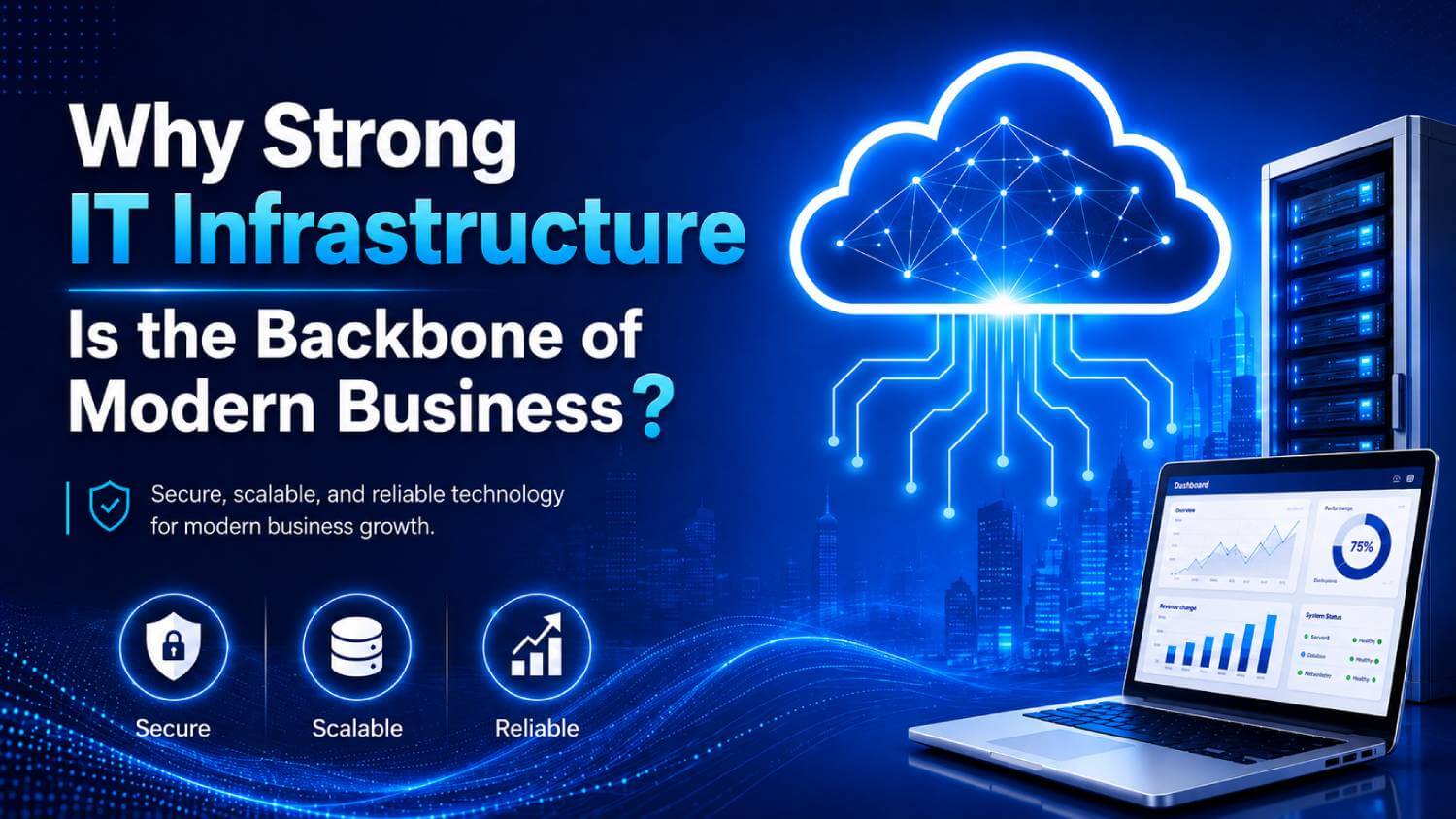
This is why Strong IT Infrastructure Is the Backbone of Modern Business.
IT Infrastructure refers to the complete set of technology resources that helps a business operate, communicate, store data, run applications, and serve customers.
It generally includes:
Servers and data centers
Computers and business devices
Internet and networking systems
Cloud platforms
Website and application hosting
Business email services
Data storage and backup systems
Cybersecurity solutions
Monitoring and technical support
When these components work together properly, employees can complete their tasks smoothly, customers can access services reliably, and management can make faster, data-driven decisions.
Modern businesses rely heavily on digital tools such as email, websites, accounting software, CRM platforms, databases, cloud applications, and communication systems.
When the underlying infrastructure fails, business operations can slow down or stop completely.
A Reliable IT Infrastructure helps ensure that critical services remain available and reduces the risk of unexpected downtime.
For businesses, this means:
Employees work more efficiently when they have access to fast, stable, and responsive technology.
Slow computers, unstable internet, inaccessible files, and application crashes can waste valuable working hours. A well-designed Modern Business Infrastructure removes these barriers.
Strong infrastructure provides:
When employees spend less time dealing with technical problems, they can focus more on customers, sales, projects, and business growth.
Business data is one of the most valuable assets of any organization.
Customer information, financial records, employee details, business documents, and internal communications must be protected from cyberattacks, unauthorized access, accidental deletion, and system failure.
A Strong IT Infrastructure supports multiple layers of Data Security, including:
Strong security not only reduces business risk but also increases customer confidence and brand credibility.
As a business grows, its technology requirements also increase.
A growing organization may need more server resources, larger storage capacity, additional users, faster applications, and better website performance.
Scalable solutions such as Cloud Infrastructure, VPS Hosting, and Dedicated Servers allow businesses to upgrade their resources whenever required.
A scalable infrastructure enables a company to:
Scalability helps businesses remain flexible and prepared for future opportunities.
Unexpected events can affect business operations at any time.
Hardware failure, cyberattacks, power outages, natural disasters, software errors, and human mistakes may result in data loss or service disruption.
A reliable infrastructure supports Business Continuity by providing:
With the right backup and recovery plan, businesses can restore essential data and resume operations quickly.
Customers expect websites, applications, payment platforms, and support channels to be available whenever they need them.
A slow website, failed transaction, or unavailable service can damage customer trust and encourage users to choose a competitor.
Strong infrastructure helps businesses deliver:
A positive digital experience improves customer satisfaction, loyalty, and brand reputation.
Remote and hybrid work have become important for many modern organizations.
Employees may need to access company files, applications, email, and internal systems from different locations.
A modern IT environment can support secure remote access through:
With the right infrastructure, employees can remain productive while the organization maintains security and access control.
Modern companies generate large volumes of data from websites, sales systems, customer interactions, financial platforms, marketing campaigns, and internal operations.
A strong infrastructure allows businesses to collect, store, process, and analyze this information efficiently.
Business leaders can then use accurate data to:
Without reliable storage, computing power, and data management systems, valuable business information may remain underused.
Risks of Weak IT Infrastructure
Businesses that rely on outdated or poorly managed infrastructure may face serious operational and security challenges.
Common risks include:
- Frequent downtime
- Slow system performance
- Data loss
- Security breaches
- Poor customer experience
- Reduced employee productivity
- Limited scalability
- Higher maintenance costs
- Difficulty adopting new technology
- Loss of customer trust
In many cases, the long-term cost of weak infrastructure is much higher than the cost of investing in reliable technology from the beginning.
Servers power websites, applications, databases, emails, and business platforms.
Depending on business requirements, organizations may use:
Shared Hosting
VPS Hosting
Cloud Servers
Dedicated Servers
Colocation Services
The right server solution should provide enough processing power, memory, storage, security, and scalability.
A fast and secure network connects employees, devices, servers, business applications, and office locations.
Strong networking infrastructure helps ensure:
Businesses should store their data in secure environments and maintain multiple backup copies.
Automated backup and disaster recovery solutions can protect organizations from:
Cloud Infrastructure gives businesses flexible access to computing resources without relying only on physical hardware.
Cloud solutions offer:
Easy scalability
Remote access
Centralized management
Lower hardware dependency
Improved collaboration
Faster deployment
Security must be integrated into every part of the IT environment.
Businesses should use:
Even the best infrastructure requires regular monitoring, maintenance, and optimization.
An experienced technical support team can:
How Alpha Net Supports Modern Businesses
Alpha Net provides reliable technology and infrastructure solutions designed to support modern businesses.
Its services can help organizations build a secure, scalable, and high-performance digital environment.
Key solutions include:
- Web Hosting
- Business Email Hosting
- VPS Hosting
- Dedicated Servers
- Cloud Solutions
- Data Center Services
- Enterprise IT Solutions
- Technical Support
With the right infrastructure partner, businesses can improve system performance, protect valuable data, reduce downtime, and prepare for future growth.
Alpha Net helps businesses establish a reliable technology foundation that supports both daily operations and long-term expansion.
For more information, visit www.alpha.net.bd
Choosing an infrastructure provider is an important business decision.
Before selecting a provider, consider the following factors:
The provider should use high-quality hardware, stable networks, reliable data centers, and active system monitoring.
The provider should offer strong security measures to protect servers, accounts, applications, and business data.
The infrastructure should be easy to upgrade as traffic, users, storage, and computing requirements grow.
A responsive and knowledgeable support team is essential for resolving issues quickly.
The provider should offer backup, redundancy, and disaster recovery options.
An experienced IT provider can better understand business requirements and recommend suitable solutions.
Businesses should not build their infrastructure through random technology purchases.
A successful infrastructure strategy should include:
Evaluating current systems
Identifying security weaknesses
Understanding operational requirements
Estimating future growth
Selecting scalable server solutions
Creating backup and recovery plans
Monitoring system performance
Reviewing infrastructure regularly
Updating outdated technologies
Working with a reliable IT partner
This structured approach helps ensure that technology investments support both current needs and future business goals.
A Strong IT Infrastructure is no longer optional for modern businesses. It is essential for productivity, security, customer satisfaction, business continuity, and long-term growth.
Reliable servers, secure networks, scalable cloud platforms, data backup systems, cybersecurity tools, and professional technical support allow organizations to operate confidently in a digital environment.
Businesses should view technology infrastructure as a strategic investment rather than a basic operating expense.
With reliable Business IT Solutions from Alpha Net, organizations can build a secure, scalable, and performance-driven technology foundation.
When the infrastructure is strong, the entire business becomes more efficient, resilient, competitive, and ready for future growth.
IT Infrastructure supports communication, data storage, websites, applications, cybersecurity, remote work, and daily business operations. Strong infrastructure helps businesses operate efficiently and avoid costly disruptions.
The main components include servers, networks, computers, software, cloud platforms, data storage, cybersecurity solutions, backup systems, and technical support.
Reliable infrastructure gives employees faster access to files, applications, communication tools, and business systems. This reduces technical delays and improves overall efficiency.
Yes. Cloud Infrastructure allows small businesses to access flexible computing resources without investing heavily in physical hardware.
A VPS provides isolated virtual resources within a physical server. A Dedicated Server provides the full physical server to one customer, offering greater control, performance, and resource capacity.
Alpha Net provides hosting, VPS, dedicated server, cloud, business email, data center, and enterprise technology solutions that help businesses build reliable and scalable IT infrastructure.
Explore professional hosting, cloud, VPS, dedicated server, business email, and data center solutions.
Get started with Alpha Net








































[All Registered Trademarks, Logo and Brand Names are properties of their respective owners]