


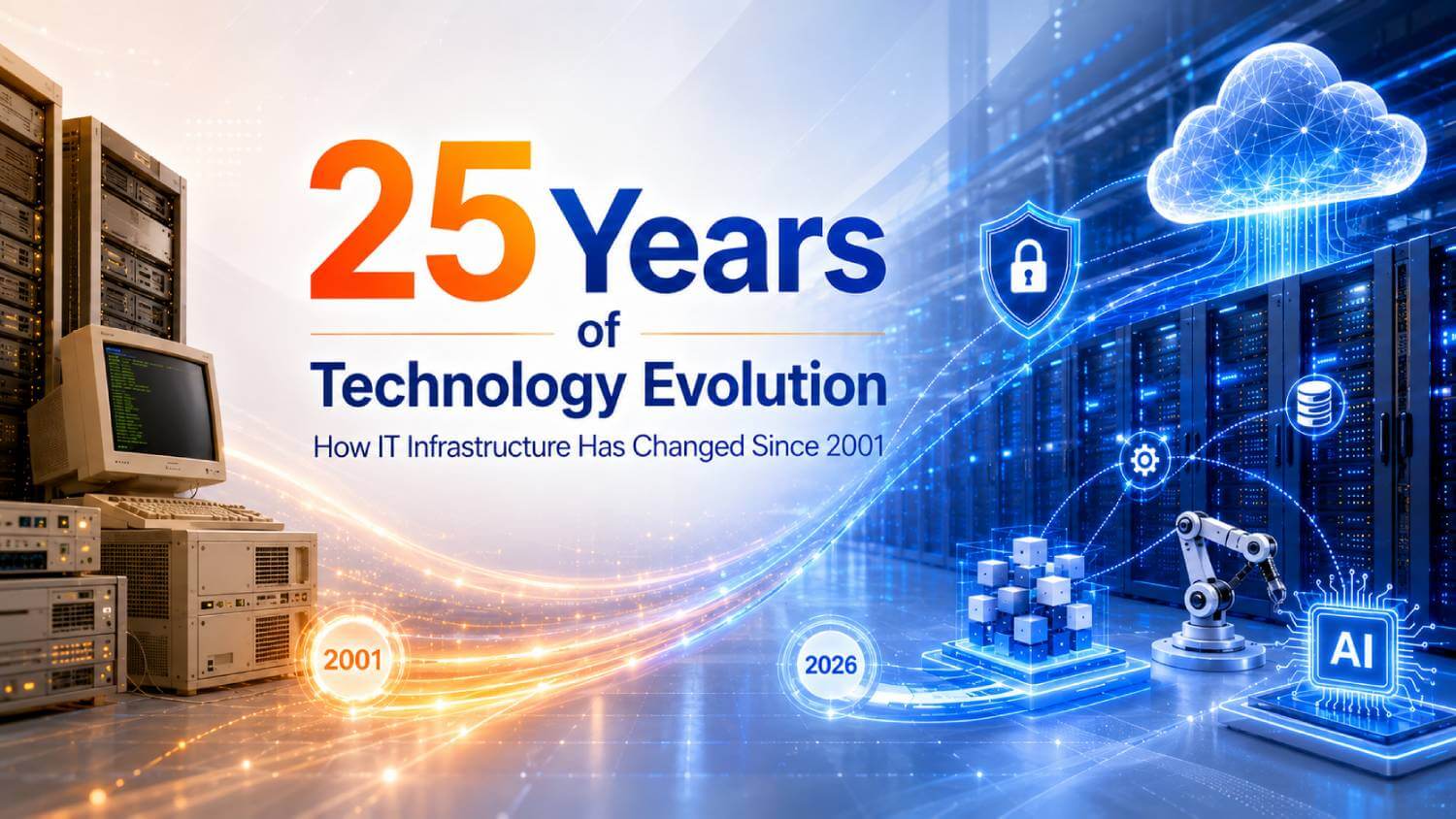
Technology has transformed dramatically over the past 25 years. In 2001, most businesses depended on physical servers, office-based networks and manually managed systems. Cloud computing was not yet mainstream, remote work was uncommon and expanding IT capacity required significant time and investment.
By 2026, businesses can deploy servers within minutes, access applications from almost anywhere, automate routine operations and use artificial intelligence to improve performance and decision-making.
The story of technology evolution since 2001 is not only about faster computers. It is about how IT infrastructure has become a strategic foundation for business growth, security and innovation.
As Alpha Net celebrates 25 years of technology, trust and innovation, let us explore the most important changes in IT infrastructure evolution since 2001.
In 2001, most business applications, databases, emails and files were hosted on physical servers. These servers were usually installed inside an office server room or hosted at a third-party data center.
Although businesses had direct control over their hardware, this model created several limitations:
Organizations had to estimate their future resource requirements before purchasing equipment. Buying insufficient capacity created performance problems, while buying too much resulted in unused resources and unnecessary expenses.
Virtualization was one of the first major breakthroughs in modern IT infrastructure.
Instead of using one physical server for one application, virtualization allowed multiple virtual servers to operate independently on a single physical machine. Each virtual machine could have its own operating system, applications and allocated resources.
Virtualization helped businesses:
It also supported the rise of Virtual Private Servers or VPS, enabling businesses to access dedicated resources without investing in an entire physical server.
Virtualization eventually became one of the foundations of cloud computing.
Cloud computing changed how organizations purchased, deployed and managed technology.
The introduction of commercially available cloud computing services allowed businesses to provision computing resources within minutes. Instead of purchasing and installing new hardware, organizations could increase or decrease resources based on actual requirements.
With cloud infrastructure, businesses gained the ability to:
Cloud computing did not eliminate the need for physical data centers. Instead, it transformed their role.
Modern data centers became the powerful foundation behind cloud platforms, hosting, colocation and managed services. Reliable power, cooling, connectivity, monitoring and physical security became essential parts of the continuing data center evolution.
IT infrastructure depends heavily on reliable connectivity.
During the early 2000s, internet connections were slower, less reliable and often limited to specific office locations. Over the last 25 years, broadband, fiber-optic networks, mobile internet and Content Delivery Networks have significantly improved how digital services reach users.
Faster connectivity has enabled businesses to provide:
Customers now expect digital services to remain available around the clock. Slow loading speeds, connectivity problems or frequent downtime can directly affect customer experience, employee productivity and business revenue.
As digital adoption grows, reliable connectivity and enterprise IT solutions in Bangladesh have become essential for organizations of every size.
Traditional applications were usually built as large, interconnected systems. Updating one component could require changes to the entire application.
Modern applications increasingly use microservices, where different functions are developed and managed as smaller, independent services.
Containers made this approach more practical by packaging applications with the components required to run consistently across various environments. Container orchestration technologies such as Kubernetes further improved how organizations deploy, scale and manage applications.
Containers and microservices have helped businesses:
These technologies have made modern IT infrastructure more adaptable to changing business requirements.
In 2001, most infrastructure-related activities were performed manually. Engineers configured servers individually, installed software by hand and often learned about problems only after users reported them.
Modern infrastructure uses automation to perform many repetitive activities consistently and efficiently.
Businesses can now automate:
Infrastructure as Code and automated deployment pipelines allow IT teams to define and manage infrastructure through repeatable configurations.
Modern managed IT services also use centralized monitoring and automation to detect unusual activities, capacity risks and performance issues before they become major disruptions.
Traditional cybersecurity mainly focused on protecting the company’s internal network. Users and devices connected from within the office were often considered trusted.
Cloud services, mobile devices, remote work and third-party integrations have made this security model less effective.
Modern cybersecurity infrastructure follows a layered and identity-based approach. Zero Trust security assumes that no user, device or connection should be automatically trusted simply because of its location.
Today’s cybersecurity strategy may include:
Cybersecurity is no longer a separate technical function. It has become an essential part of business continuity, reputation and customer trust.
The workplace of 2001 was primarily connected to a physical office. Employees depended on desktop computers, local networks and on-site applications.
Today, employees can work from offices, homes, customer locations or while travelling. They can access cloud applications, virtual desktops, communication platforms and business systems through secure internet connections.
This transformation requires businesses to maintain:
The modern workplace is no longer defined by one physical location. It is a securely connected digital environment.
Artificial intelligence, advanced analytics and automation are shaping the latest stage of digital transformation.
AI workloads may require powerful computing resources, high-speed storage, reliable connectivity and well-managed data. AI-assisted monitoring can also help IT teams identify unusual patterns, predict resource requirements and respond to technical issues faster.
However, adopting an AI tool alone does not make a business AI-ready. Organizations need a reliable infrastructure foundation that includes:
Modern businesses must prepare not only for growth but also for cyberattacks, hardware failures, unexpected traffic and connectivity disruptions.
A successful infrastructure strategy must balance performance, security, scalability, cost and business continuity.
| Infrastructure in 2001 | Infrastructure in 2026 |
|---|---|
| Primarily physical and office-based | Physical, virtual, cloud and hybrid |
| Large upfront hardware investment | Flexible and scalable resource models |
| Manual server configuration | Automation and Infrastructure as Code |
| Perimeter-based security | Layered and Zero Trust security |
| Reactive troubleshooting | Continuous and proactive monitoring |
| Limited remote access | Secure access from almost anywhere |
| Large and infrequent software releases | Continuous delivery and microservices |
| IT mainly supported operations | IT directly enables business strategy |
The last 25 years have created remarkable opportunities, but infrastructure decisions have also become more complex.
Businesses must now select the right combination of on-premises infrastructure, colocation, cloud services and hybrid environments. They must improve performance, maintain availability, protect sensitive data and control costs while technology continues to evolve.
There is no single infrastructure model that works for every organization. The right solution depends on several factors:
Working with an experienced technology partner can help organizations make informed decisions and develop an infrastructure strategy aligned with their long-term goals.
Alpha Net’s 25-year journey reflects the broader transformation of the technology industry.
Since 2001, technology requirements have evolved from basic connectivity and physical servers to secure, scalable and continuously available digital infrastructure.
With experience in enterprise connectivity, hosting, cloud, data center and managed technology services, Alpha Net helps organizations build infrastructure according to their actual business requirements.
The objective is not simply to implement more technology. It is to create a secure and reliable foundation that supports innovation, growth and business continuity.
The next era of technology will introduce more intelligent systems, greater automation and new security challenges. Organizations that modernize their infrastructure thoughtfully today will be better prepared for tomorrow.
Build the next chapter of your digital infrastructure with Alpha Net.
Build the next chapter of your digital infrastructure with Alpha Net.
Visit alpha.net.bd to explore reliable technology solutions for your organization.
IT infrastructure evolution refers to the transformation of business technology from physical servers, local networks and manual processes into virtualized, cloud-connected, automated and security-focused systems.
Cloud computing enables businesses to deploy resources faster, scale according to demand, support distributed teams and reduce dependence on locally installed hardware.
Yes. Physical data centers provide the power, cooling, connectivity, security and hardware foundation behind cloud computing, hosting, colocation and other digital services.
Businesses should assess their workloads, performance requirements, security risks, compliance obligations, growth plans, recovery objectives, available expertise and budget.
Alpha Net can help organizations evaluate their requirements and identify suitable connectivity, hosting, cloud, data center and managed IT services to create a secure, scalable and reliable technology foundation.










































[All Registered Trademarks, Logo and Brand Names are properties of their respective owners]